Guide · EVs & charging
Do I need a dedicated EV charger at home?
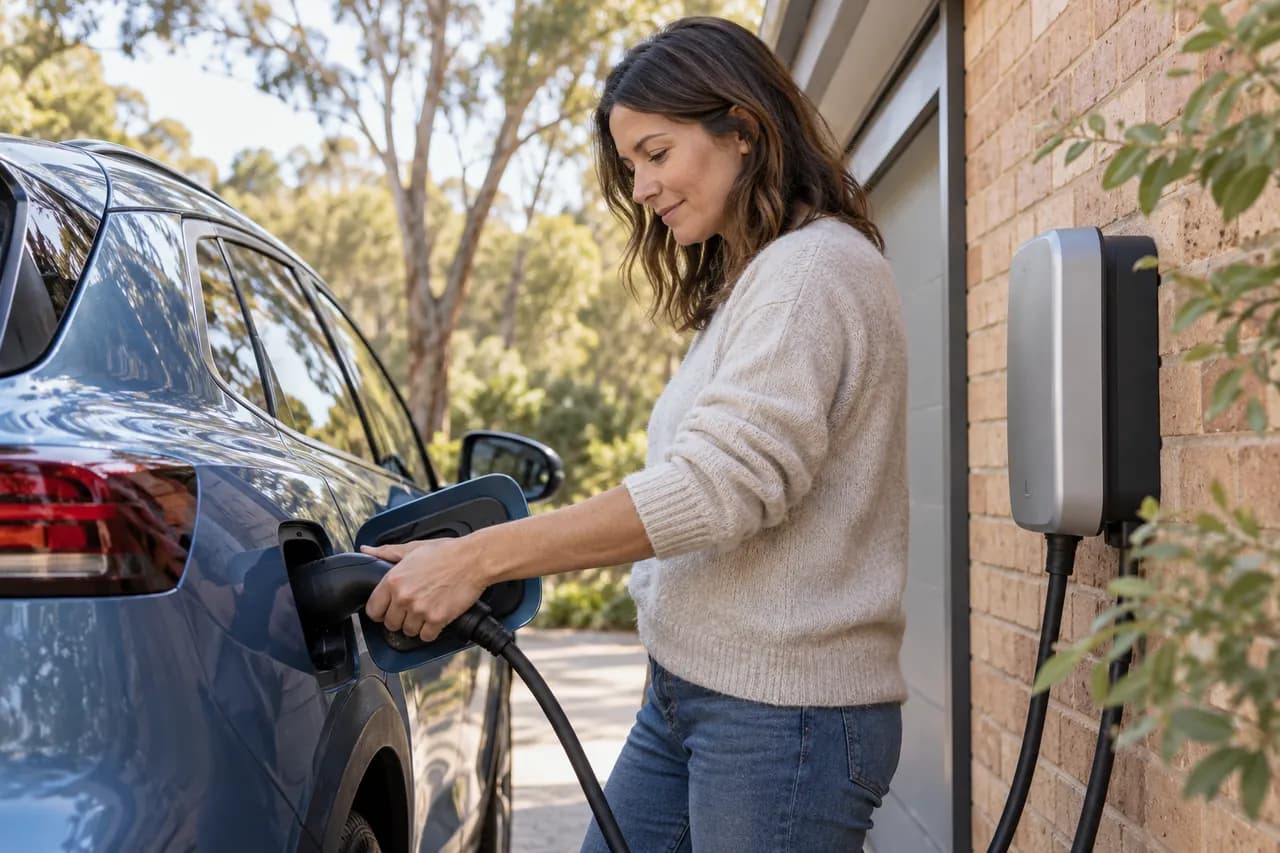
Not always. An appropriate portable charging cable and a suitable power point may provide enough charging for your daily driving. A dedicated charger becomes more useful when you need faster replenishment, have a short charging window or want features such as solar-surplus charging.
At a glance
The guide in a minute.
- Start with daily driving. Work out the energy to replace and the hours you can charge.
- Check your charging window. A faster charger may help you use a short, cheaper charging period.
- Check the electrical setup. Ask a licensed electrician to assess the outlet, circuit and installation.
- Choose compatible equipment. Check your car’s AC charging limit and the features you will use.
Inside the guide
Not always. An appropriate portable charging cable and a suitable power point may provide enough charging for your daily driving. A dedicated charger becomes more useful when you need faster replenishment, have a short charging window or want features such as solar-surplus charging.
5 chapters. Jump to what you need, or read from the start.
Before you start
We suggest beginning with daily driving and time parked at home. Replacing one day’s energy is a different job from replenishing a near-empty battery after a long trip. Check both the normal routine and the occasional demanding day, then compare the setup with the electricity plan you will use.
Work out your daily top-up
Here is an illustrative household. The driver travels 35 km a day, and the car uses 18 kWh per 100 km at the battery. That is 6.3 kWh to replace.
At an assumed 90% charging efficiency, the charger needs to supply about 7 kWh. A portable setup drawing 2 kW would take about three and a half hours. A setup supplying 7 kW would take about an hour.
Those are simplified calculations, not promised charging times. Actual power and losses vary, and the charging setup must be suitable.
Australian Government guidance puts standard-power-point charging at up to 2.4 kW. A particular portable cable or vehicle setting may use less. Dedicated home AC chargers commonly sit in the 7 to 22 kW range, with the vehicle’s own AC limit helping determine the actual rate.
The same top-up at different charging powers
The long-trip column assumes a 60 kWh usable battery moving from 20% to 80%: 36 kWh into the battery, or 40 kWh from the wall at 90% efficiency.
| Illustrative charging power | About 7 kWh daily top-up | About 40 kWh after a long trip |
|---|---|---|
| 2 kW portable setup | About 3.5 hours | About 20 hours |
| 2.4 kW, the guidance figure for a standard power point | About 2.9 hours | About 16.7 hours |
| 7 kW dedicated charger, if the car accepts 7 kW | About 1 hour | About 5.7 hours |
These are simple divisions. A car with a lower AC limit will charge more slowly than the charger’s rating.
For the example driver parked overnight, a safe slower setup could cover the daily top-up. For someone arriving late after a long drive and leaving early, faster charging may be much more valuable.
Write down how often your long-trip days actually occur. An occasional one may be covered by a slower setup over a weekend; frequent ones make the faster rate easier to justify.
Now check the cheap window. In the example, a two-hour window at 2 kW supplies only 4 kWh of the 7 kWh required from the wall. The remaining energy needs another period. A faster charger may fit the top-up into the window, but compare its installed cost with the actual benefit.
A longer window changes the answer. Offer details checked 13 October 2026: our evEnergy Saver plan (opens in a new tab) offers 12 cents per kWh from midnight to 6 am AEST for eligible ACT residential EV owners with a smart meter. Six hours at 2 kW supplies about 12 kWh from the wall, which covers the example’s 7 kWh daily top-up without a faster charger. During daylight saving, midnight AEST is 1 am local time, so check how the car or charger schedule handles the clock.
The plan’s free grid-electricity periods, noon to 2 pm AEST on Saturdays and Sundays, are shorter: about 4 kWh at 2 kW, or about 14 kWh for a car drawing 7 kW, before losses. Terms and fair use apply; see the cheapest time to charge.
10 kWh from the wall adds about 9 kWh to the car in a 90% efficiency example; about 1 kWh is lost. Actual charging losses vary. If a consumption figure already includes losses, count them once.
Energy at the wall is not all energy in the car.
10 kWh from the wall
A 90% efficiency example. Actual charging losses vary.
If a consumption figure already includes losses, count them once.
Check the power point before relying on it
An available socket is a reason to investigate charging, rather than assume the installation is suitable for regular, prolonged use.
Ask a licensed electrician to assess the outlet, circuit and electrical setup. Follow the vehicle and charging-equipment instructions, and plug the cable directly into a suitable power point rather than an extension lead or power board.
What to ask the electrician
- Is this outlet and circuit suitable for several hours of charging most days?
- Is the circuit shared with other large appliances?
- Would a faster charger need a dedicated circuit, switchboard work or a supply change?
- Is the home on a single-phase or three-phase supply, and what does that mean for the equipment?
A three-phase charger does not ensure the car will charge at its advertised maximum. Check the vehicle’s AC charging limit and the installation requirements before ordering equipment.
Also think about where the car parks. The cable needs to reach safely without creating a trip hazard or relying on an improvised route.
For a rental or shared apartment garage, begin with parking rights and the owner or strata approval route. A shared installation also needs a plan for electricity metering, payment and future users. Ask about the building’s approach before paying for an individual charger.
A permanent charger may need both the owner’s agreement and approval for common property. Settle who approves, who pays and how charging is measured before booking an installer.
Buy features you will use
A dedicated charger can offer more than speed. Depending on its equipment and configuration, it may schedule charging, follow spare solar generation or manage its load alongside other appliances.
Ask which features are included and what extra metering or communications they need. Check that the charger works with your car and that its usable speed matches the power available at home.
| Feature | When it may help | What to ask |
|---|---|---|
| Scheduling | Your plan has a cheaper charging window | Does it follow the tariff clock, and can you override it easily? |
| Solar-surplus charging | The car is often home during sunny hours | What extra metering or components are needed to measure the surplus? |
| Load management | Charging could overlap other large appliances | Which loads does it watch, and how does it adjust charging? |
| Bidirectional charging | You want the car to supply the home | Is your exact car and charger combination supported, with network approval? |
A timer knows it is noon; a properly configured solar-aware controller responds to how much spare electricity is actually available. Solar charging still costs the export credit you give up. If you also have a home battery, ask whether it would supply the car automatically and which settings change that. Read Could the car in your driveway power your home? before paying extra for bidirectional features.
Get an installed quote covering the charger, cable route, circuit protection, labour and any switchboard or supply changes. Ask which permissions and extra metering are included, and who handles warranty and support. Compare the same scope across quotes.
The best first purchase may be an assessment. Take your electrician the car model, usual daily kilometres, parking hours and any cheap electricity window you want to use. Then ask for the simplest safe setup that meets those needs.
If a safe slower setup covers your routine, compare the extra installed cost of a dedicated charger with the time, convenience and features you would gain. You can make that decision after an assessment, rather than assume every EV purchase needs a wall charger.
Related advice: When is the cheapest time to charge an electric car? · Could the car in your driveway power your home?
Put the charging setup and plan together
If a dedicated charger suits your routine, our evEnergy Saver page (opens in a new tab) includes links to home-charging partner offers. Check each partner’s terms, installation scope and address coverage. Have a licensed electrician confirm the installation and equipment suitability.
An EV plan can change what the rest of the household pays. Compare the home and car together using the same annual usage, including the daily charge, solar credits and any electricity bought outside the cheap window. If you’re in NSW, compare the plans available for your address (opens in a new tab).
In the ACT, the Sustainable Household Scheme lists EV charging among its eligible home upgrades. As at 13 October 2026, eligible new applicants can borrow $2,000 to $20,000 at 3% interest over up to ten years. A loan changes when you pay rather than reducing the cost. Our Sustainable Household Scheme explainer covers eligibility and repayments.
Your checklist, at your pace.
Questions people also ask
Quick answers.
Can I charge an electric car from a normal power point?
Often, yes, with an appropriate portable charging cable, provided a licensed electrician has confirmed the outlet and circuit are suitable for regular, prolonged use. Australian Government guidance puts standard-power-point charging at up to 2.4 kW, and a particular cable or vehicle setting may use less. Plug the cable directly into the power point rather than an extension lead or power board, and follow the vehicle and equipment instructions.
Do I need a dedicated EV charger at home?
Not always. If the car is parked at home for long enough, a safe slower setup may replace your daily driving. A dedicated charger becomes more useful when you need faster replenishment, have a short charging window or want features such as scheduling or solar-surplus charging. Compare its extra installed cost with the time and convenience you would gain.
How long does it take to charge an EV at home?
It depends on how much energy you need to replace and the charging power. As an illustration, driving 35 km in a car using 18 kWh per 100 km needs about 7 kWh from the wall at an assumed 90% charging efficiency. That takes about three and a half hours at 2 kW, or about an hour at 7 kW. Actual power and losses vary, and the car’s own AC charging limit can slow the rate.
How fast is a home EV wall charger?
Dedicated home AC chargers commonly sit in the 7 to 22 kW range, but the vehicle’s own AC charging limit helps determine the actual rate. A more powerful charger cannot make the car accept power above that limit, and a three-phase charger does not ensure the car will charge at its advertised maximum. The home’s supply and circuits also matter, so check them with a licensed electrician.
Can I install an EV charger in a rental or apartment?
Possibly, but start with parking rights and approval rather than the charger. A permanent charger may need both the owner’s agreement and approval for common property. A shared installation also needs a plan for electricity metering, payment and future users. Agree who approves the work, who pays and how charging will be measured before booking an installer.
What is the cheapest time to charge an EV at home?
The cheapest time is the lowest-cost period you can actually use while still being ready for the next trip. Offer details checked 13 October 2026: our evEnergy Saver plan offers 12 cents per kWh from midnight to 6 am AEST for eligible ACT residential EV owners with a smart meter, with free grid electricity from noon to 2 pm AEST on Saturdays and Sundays. Terms and fair use apply. Compare the whole household bill, not just the charging rate.
Sources12
- ACT Government, ‘Sustainable Household Scheme Guidelines for Participants’, Climate Choices (September 2026), https://www.climatechoices.act.gov.au/__data/assets/pdf_file/0010/1861570/Sustainable-Household-Scheme-guidelines-for-participants.pdf (opens in a new tab), accessed 12 October 2026.
- ACT Government. ‘Bidirectional charging’. Climate Choices. n.d. https://www.climatechoices.act.gov.au/transport-and-travel/zero-emissions-vehicles/bidirectional-charging (opens in a new tab) (accessed 13 October 2026).
- ACT Government. ‘Sustainable Household Scheme’. Climate Choices. n.d. https://www.climatechoices.act.gov.au/policy-programs/sustainable-household-scheme (opens in a new tab) (accessed 13 October 2026).
- ActewAGL. ‘Compare plans’. ActewAGL. n.d. https://www.actewagl.com.au/for-home/compare (opens in a new tab) (accessed 13 October 2026).
- ActewAGL. ‘Contact us’. ActewAGL. n.d. https://www.actewagl.com.au/contact-us (opens in a new tab) (accessed 13 October 2026).
- ActewAGL. ‘evEnergy Saver’. ActewAGL. n.d. https://www.actewagl.com.au/energy-plans/evenergy-saver (opens in a new tab) (accessed 13 October 2026).
- ActewAGL. ‘Pricing plans for home smart meters’. actewagl.com.au. n.d. https://www.actewagl.com.au/legal/pricing-information/pricing-plans-for-home-smart-meters (opens in a new tab) (accessed 13 October 2026).
- Australian Government. ‘Charging options for houses and strata buildings’. energy.gov.au. n.d. https://www.energy.gov.au/electric-vehicles/owning-electric-vehicle/charging-options-houses-and-strata-buildings (opens in a new tab) (accessed 13 October 2026).
- Australian Government. ‘Electric vehicle charging equipment’. energy.gov.au. n.d. https://www.energy.gov.au/electric-vehicles/owning-electric-vehicle/electric-vehicle-charging-equipment (opens in a new tab) (accessed 13 October 2026).
- Australian Government. ‘How to charge your electric vehicle’. energy.gov.au. n.d. https://www.energy.gov.au/electric-vehicles/owning-electric-vehicle/how-charge-your-electric-vehicle (opens in a new tab) (accessed 13 October 2026).
- Your Home. ‘Smart homes and energy management’. YourHome. n.d. https://www.yourhome.gov.au/energy/smart-homes (opens in a new tab) (accessed 13 October 2026).
- Your Home: electric vehicles (opens in a new tab). Accessed 16 October 2026.