Guide · Hot water
Choosing heat-pump hot water.
Tank size, winter recovery, your tariff and the installation all matter. Work through them together before replacing the system.
At a glance
The guide in a minute.
- Start with the busy period. Back-to-back showers and reheating time matter alongside household size.
- Check local winter recovery. Ask about the exact model, booster and installation location.
- Compare your own energy prices. A running-cost figure is only useful with its assumptions.
- Check the whole installation. Electrical work, removal, noise and permissions belong in the quote.
Inside the guide
Tank size, winter recovery, your tariff and the installation all matter. Work through them together before replacing the system.
5 chapters. Jump to what you need, or read from the start.
Understand what changes.
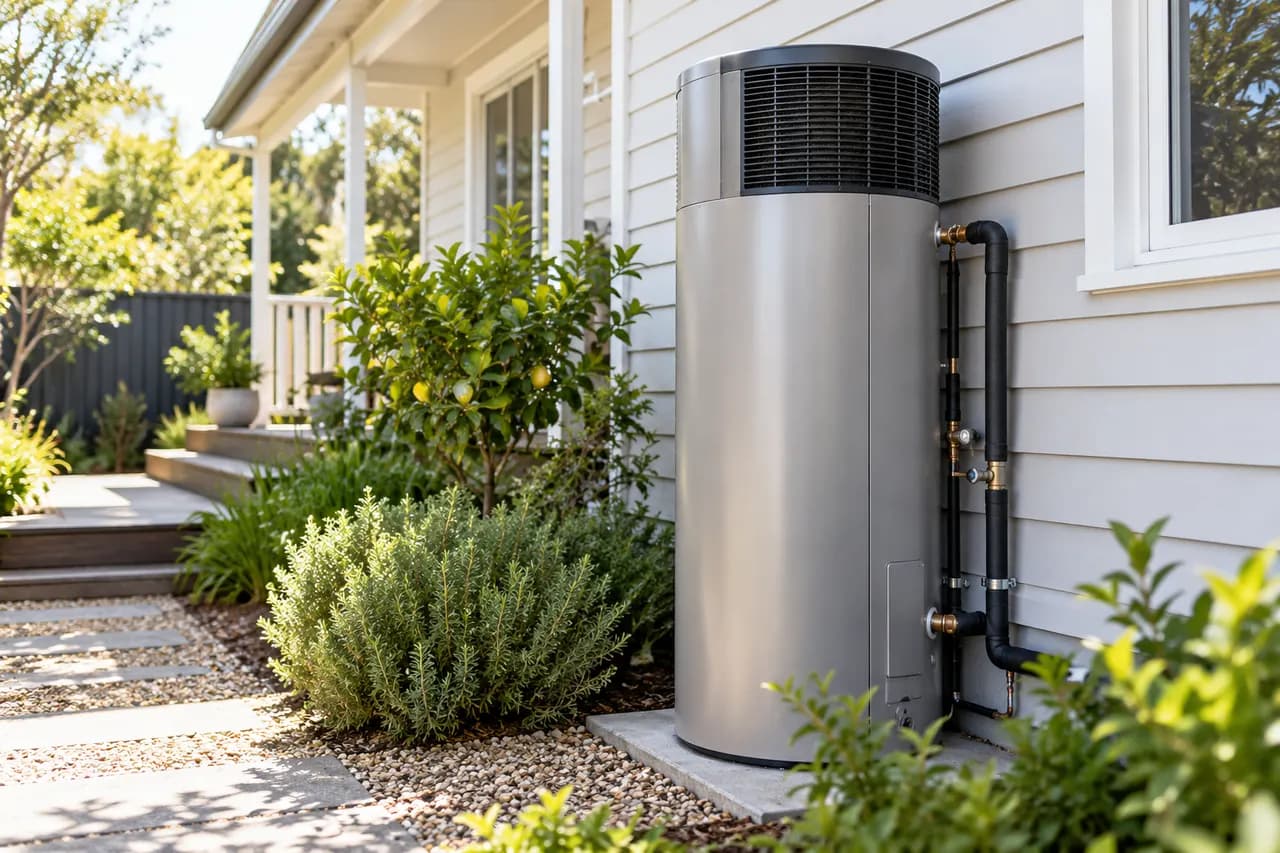
A heat pump moves heat from the surrounding air into the water. Its electricity use depends on the model, air temperature, water temperature and operating conditions. A published efficiency figure is not a promise that every household will use the same amount of energy.
How much heat does the water need?
The heat depends on how much water is heated and by how many degrees. Our running-cost comparison works it out as litres × 4.186 × temperature rise ÷ 3,600, which gives kilowatt-hours of heat. For scale, heating 250 litres of water by 20°C needs about 5.8 kWh of heat, ignoring heat losses.
A conventional electric element and a heat pump need different amounts of electricity to add that heat. Heat-pump efficiency is described as a coefficient of performance, or COP: the heat delivered divided by the electricity used. At an illustrative COP of 3, the heat pump would use about 1.9 kWh of electricity for the same 5.8 kWh of heat. Seasonal and installed performance varies, so treat that as a way to understand the comparison rather than a forecast for your home.
If your existing system has failed, tell the installer first. Ask about replacement timing and temporary hot water as well as the longer-term choice. Before agreeing, get the exact model, the complete price and any nomination or approval requirements, and base the budget on support confirmed today.
Size it for the busiest part of the day.
Write down who showers, how long for and whether the showers happen close together. Include baths, visitors and other significant hot-water use. A daily litres benchmark and a tank capacity are different quantities.
Your Home uses about 50 litres of hot water per person per day as a general planning guide. That describes use across the day, not the size of tank to buy. Our guide to what size hot-water system you need explains the difference.
Several showers close together need enough usable stored water and enough recovery time. Ask what happens after that peak, particularly if a timer will restrict the heating hours. When you change system type, have the installer size the replacement for your household rather than simply matching the old unit’s number.
Use our hot-water sizing tool to prepare a starting range and an installer checklist. Ask the installer to explain how the exact model recovers before the next busy period, including in winter.
One unit of electricity to operate the system, plus two units of heat moved from the outside air, gives three units of heat to the water: an example coefficient of performance (COP) of 3.
A heat pump moves heat. It does not just make it.
Electricity in
1 unit
To operate the system
Heat from air
2 units
Moved from outside air
Heat to water
3 units
An example COP of 3
An efficiency example, not a year-round performance promise.
Check your part of the region.
In colder inland locations, ask about heat-pump-only operation, defrosting, recovery time and booster use. In milder coastal locations, the site still needs an assessment. Noise, airflow, corrosion exposure and the available space can matter.
The ACT Government’s heat-pump buyer guide recommends checking that the model can operate on the heat pump alone down to −5°C. The Australian Government also notes that not all heat pumps are designed for cold locations. An operating-temperature limit alone does not prove the system will recover enough hot water, so ask for a cold-day recovery explanation for the exact tank and heat pump, and when the booster would run.
Ask for the model’s operating-temperature range and sound information, then have the installer explain its proposed position. A specification sheet does not replace checking the installation against your home and neighbouring properties.
Questions for the site visit
- Where will the tank and compressor go, and what clearances do they need?
- What does the noise assessment say about that position?
- Does the location need electrical, plumbing, switchboard or circuit work?
- Who handles a fault with the compressor, tank or electronics, and is service travel included?
- Will the proposed schedule still let the system complete its approved temperature settings and hygiene cycles?
Ask for the positions, clearances and noise assessment in the written proposal. That makes two quotes easier to compare, particularly when one headline price covers less of the job.
Compare running costs without borrowing another home’s bill.
Our running-cost comparison uses the hot-water demand, energy prices and efficiency assumptions you enter. It shows the working rather than scaling a fixed annual saving by household size. It leaves out standing losses, seasonal efficiency, booster use, installation costs, maintenance and supply charges, so keep those in the conversation with the installer.
Solar electricity also has a value: the export credit you forgo. If the tank sometimes needs grid electricity or a booster, include that in the discussion. A cheaper tariff window only helps if it is long enough and leaves enough hot water for the next busy period.
A worked comparison
Take the earlier example: about 1.9 kWh of electricity to deliver 5.8 kWh of heat at an illustrative COP of 3. Here is what that one heating run would cost from three sources, using example values rather than a live tariff:
| Electricity source | Illustrative value per kWh | Cost for about 1.9 kWh |
|---|---|---|
| Grid electricity | 35 cents | About 67 cents |
| Cheaper grid period | 12 cents | About 23 cents |
| Otherwise-exported solar | 5 cents feed-in credit | About 10 cents in forgone credits |
The solar figure assumes the whole run comes from surplus that would otherwise be exported. A timer knows the time, not how much solar is available, so a scheduled daytime run can draw grid electricity when generation is low. Price any grid top-up or booster use at the rate that actually applies.
Check the hot-water tariff on your bill as well. A separate controlled-load circuit can have different supply times and rates from the rest of the house, and an existing controlled-load circuit does not automatically gain access to a plan’s general free-power period. If the arrangement changes with the new system, have the retailer explain the resulting charges before relying on a running-cost estimate.
If hot water is your last gas appliance, ask what disconnecting gas would involve. Do not count the entire gas supply charge as a saving while other gas appliances keep the connection in use. Turning the old appliance off does not by itself close the account. ACT guidance distinguishes disconnection, which closes the account and caps the gas line, from abolishment, which permanently removes the connection.
An illustrative day: showers around 06:00 to 08:00 draw the tank down, it reheats from about 11:00 to 15:00, and showers around 19:00 to 21:00 draw it down again. The tank bridges the time between demand and the next reheat.
Size for the busy period, not just the daily total.
Illustrative day
A tank bridges the time between demand and the next reheat.
Timing, storage and recovery rate all matter.
Get the complete price and support checked.
Ask for the tank, installation, electrical work, removal and commissioning on an itemised quote. Ask which rebates or certificates are already deducted and what eligibility evidence is needed.
| Quote item | What to confirm |
|---|---|
| Heat pump and tank | The exact model, supply and installation |
| Electrical and plumbing work | Any switchboard or circuit changes, and whether they sit inside the headline price |
| The old system | Removal, site access and any quoted travel costs |
| Support | Discounts already included, any later reimbursement and the final amount you pay |
| Payment and warranty | The deposit, payment dates, warranty responsibilities and exclusions |
What support might apply
As at 13 October 2026:
- ACT rebate: eligible Home Energy Support households can receive up to 50% of approved costs, capped at $2,500, in a category hot water shares with heating and cooling, electric cooking and ceiling insulation. Get approval before accepting a quote. The rebate-only route requires payment before reimbursement.
- NSW discount: the Energy Savings Scheme publishes indicative discounts of up to $640 when replacing electric hot water with a heat pump, or up to $330 when replacing gas. The actual discount depends on the installer, model, location and job. Complete the nomination paperwork before installation.
- Finance: the ACT Sustainable Household Scheme has standard 3% finance. Eligible NSW owners and landlords can apply for Home Energy Saver loans of up to $15,000 at zero interest. Borrowing changes how you pay for the work; it is not itself a saving.
Use our ACT and NSW heat-pump rebate explainer for the current support routes, eligibility rules and application order. Keep a confirmed discount, a later reimbursement and any loan repayments separate. Then compare the proposed system with the same household use and comfort needs.
Our hot-water upgrade offer (opens in a new tab) is for eligible ACT homes with an ActewAGL electricity plan and an existing gas hot-water system. Check its terms before requesting a quote.
Your checklist, at your pace.
Questions people also ask
Quick answers.
Do heat-pump hot-water systems work in a Canberra winter?
It depends on the exact model and installation. The ACT Government’s heat-pump buyer guide recommends checking that the model can operate on the heat pump alone down to −5°C, and the Australian Government notes that not all heat pumps are designed for cold locations. Ask the installer how the exact tank and heat pump will recover after your busiest showers on a cold morning, and when any booster would run.
How much does a heat-pump hot-water system cost to run?
There is no single figure that suits every home. The cost depends on how much hot water you use, how much the water is heated, the model’s efficiency in your conditions and the price of the electricity it uses. At an illustrative COP of 3, a heat pump uses one unit of electricity for every three units of heat it delivers to the water. Our running-cost comparison lets you enter your own hot-water demand, prices and efficiency assumptions.
What rebates are available for heat-pump hot water in the ACT and NSW?
As at 13 October 2026, eligible ACT Home Energy Support households can receive up to 50% of approved costs, capped at $2,500, in a category hot water shares with heating and cooling, electric cooking and ceiling insulation. In NSW, the Energy Savings Scheme publishes indicative discounts of up to $640 when replacing electric hot water with a heat pump, or up to $330 when replacing gas. Both routes have steps to complete before the work starts, so check the current conditions for your address before booking.
Should I run my heat pump on solar or off-peak electricity?
Use the lowest-cost period that still leaves enough hot water for your next busy period. Solar that would otherwise be exported costs you the feed-in credit you give up. A timer knows the time, not how much solar is available, so a daytime run can draw grid electricity when generation is low. Whichever schedule you choose, have the installer confirm it suits the exact model and circuit and still lets the system complete its required hygiene cycles.
Are heat-pump hot-water systems noisy?
A heat pump has a compressor, so its sound and position are worth checking before installation. Ask for the model’s sound information and a noise assessment for the proposed position, and have the installer set out the placement and clearances in the written proposal. A specification sheet does not replace checking the installation against your home and neighbouring properties.
Will switching to a heat pump get rid of my gas supply charge?
Only if hot water is your last gas appliance and you then close the gas account and arrange the appropriate disconnection or abolishment. While other gas appliances remain in use, the connection and its supply charge stay. Turning an appliance off does not by itself complete that process, so ask the retailer about the steps and any fees before counting the saving.
Sources12
- Your Home: hot water services (opens in a new tab). Accessed 16 October 2026.
- ActewAGL water heating upgrades (opens in a new tab). Accessed 16 October 2026.
- ACT Government, ‘Singing in the Shower: A Guide to Hot Water Heat Pumps’, Climate Choices (n.d.), https://www.climatechoices.act.gov.au/policy-programs/sustainable-household-scheme/buyers-guides/singing-in-the-shower-a-guide-to-hot-water-heat-pumps (opens in a new tab), accessed 13 October 2026.
- Australian Government, ‘Hot Water Systems’, energy.gov.au (n.d.), https://www.energy.gov.au/households/hot-water-systems (opens in a new tab), accessed 12 October 2026.
- ACT Government, ‘Home Energy Support: Rebates for Homeowners’, Climate Choices (n.d.), https://www.climatechoices.act.gov.au/policy-programs/home-energy-support-rebates-for-homeowners (opens in a new tab), accessed 12 October 2026.
- ACT Government, ‘Sustainable Household Scheme’, Climate Choices (n.d.), https://www.climatechoices.act.gov.au/policy-programs/sustainable-household-scheme (opens in a new tab), accessed 13 October 2026.
- ACT Government, ‘Switching Off Your Gas Connection’, Make Your Next Choice Electric (n.d.), https://energy.act.gov.au/switching-off-your-gas-connection/ (opens in a new tab), accessed 12 October 2026.
- ActewAGL, ‘Hot Water Heat Pump Upgrade’, ActewAGL (n.d.), https://www.actewagl.com.au/for-home/energy-efficient-homes/hot-water-heat-pump-upgrade (opens in a new tab), accessed 13 October 2026.
- Australian Energy Regulator, ‘Which Type of Energy Tariff Is Right for You’, Australian Energy Regulator (updated 20 June 2024), https://www.energymadeeasy.gov.au/article/electricity-tariffs (opens in a new tab), accessed 13 October 2026.
- Building and Plumbing Commission. ‘Hot water safety’. Victorian Government. n.d. https://www.bpc.vic.gov.au/resource-hub/safety-guides/hot-water-safety (opens in a new tab) (accessed 13 October 2026).
- NSW Government, ‘Hot Water Upgrade Incentive’, NSW Climate and Energy Action (updated 6 February 2026), https://www.energy.nsw.gov.au/households/grants-rebates/household-energy-saving-upgrades/hot-water-upgrade-incentive (opens in a new tab), accessed 12 October 2026.
- NSW Government, ‘Home Energy Saver’, NSW Climate and Energy Action (updated 7 August 2026), https://www.energy.nsw.gov.au/households/grants-rebates/home-energy-saver (opens in a new tab), accessed 13 October 2026.